littlefs
v2.11.3Features
-
Power-loss resilience with strong copy-on-write guarantees for all file operations.
-
Dynamic wear leveling across flash blocks to extend storage lifespan.
-
Bad block detection and automatic workaround capabilities for NAND/NOR flash.
-
Strictly bounded RAM and ROM usage that remains constant regardless of filesystem size.
-
Elimination of unbounded recursion to prevent stack overflow in constrained environments.
-
Configurable, potentially static buffers to avoid dynamic memory allocation.
-
Full POSIX-like API for file and directory management.
-
Atomic POSIX operations including file removal and renaming.
-
Metadata stored in small logs called metadata pairs for efficient, low-latency updates.
-
File data stored in copy-on-write structures to prevent wear amplification.
-
C99 compliant source code for maximum portability across embedded compilers.
-
Support for multiple simultaneous filesystem instances via user-allocated state structures.
-
Data integrity verification through read-back checks during write operations.
-
Customizable block device interface for read, program, erase, and sync operations.
-
Support for custom error codes returned from underlying block device drivers.
-
Integrated test suite for PC/Linux environments using emulated block devices.
Architecture
littlefs is architected as a block-based filesystem utilizing a “two-layered cake” design to balance performance and reliability. The first layer consists of metadata pairs, which are small logs used to store directory information and file metadata. These logs allow for fast, frequent updates to metadata anywhere on the storage medium without requiring large-scale erases. The second layer uses larger copy-on-write (COW) structures to store actual file data, ensuring that data is stored compactly and that updates do not cause unnecessary wear amplification.
At the core of the system is a common block allocator that services both metadata and data structures. This allocator implements dynamic wear leveling by tracking and limiting the number of erases allowed on a block per allocation cycle. The system is designed to be entirely reentrant and supports multiple instances by requiring the user to provide the state storage (lfs_t) and configuration (lfs_config). This design ensures that RAM usage is strictly bounded and predictable, as the filesystem does not use recursion or unbounded dynamic memory allocation.
Use Cases
This library is ideal for:
- IoT Edge Devices: Systems requiring high reliability during unpredictable power cycles or battery failures.
- Data Logging: Applications that need to write data frequently to flash while maximizing the lifespan of the hardware through wear leveling.
- Embedded Firmware Storage: Storing system configurations and firmware images where corruption could lead to device bricking.
- Resource-Constrained MCUs: Microcontrollers with very limited RAM (e.g., <10KB) where a traditional filesystem would be too heavy.
- NAND/NOR Flash Management: Devices using raw flash chips that require manual bad block management and wear leveling.
Getting Started
To integrate littlefs, developers must first define a lfs_config structure that specifies the block device dimensions (read size, program size, block size, and count) and provides function pointers for the hardware-specific read, prog, erase, and sync operations. Once the configuration is defined, the filesystem can be initialized using lfs_mount. If the mount fails (common on first boot), lfs_format can be called to create a fresh filesystem.
Detailed API documentation is located within the lfs.h header file. For developers looking to port the library, the DESIGN.md and SPEC.md files in the repository provide deep dives into the on-disk format and architectural tradeoffs. Testing can be performed on a development PC using the provided emulated block device and the Python-based test runner found in the scripts directory.
Related Projects (144)
View All 144 Projects →BreadboardOS
BreadboardOS is a firmware platform for the Raspberry Pi RP2xxx family designed for rapid prototyping with a focus on a command-line interface. Built on FreeRTOS, it integrates the LittleFS filesystem and microshell to provide a POSIX-like environment for interacting with hardware peripherals and managing system tasks.

BresserWeatherSensorLW
A LoRaWAN-enabled bridge for Bresser 868 MHz weather sensors based on ESP32 and RP2040 microcontrollers. It utilizes the RadioLib library to receive sensor data via FSK and transmit it to LoRaWAN networks like The Things Network, ChirpStack, or Helium, while focusing on low-power operation and extensive sensor support.
ramrsbd: Reed-Solomon Error-Correcting Block Device
An implementation of a Reed-Solomon based error-correcting block device backed by RAM, designed for use with the littlefs file system. It provides a robust mechanism for detecting and correcting a configurable number of byte errors, serving as both a functional driver and an educational resource on finite-field mathematics.
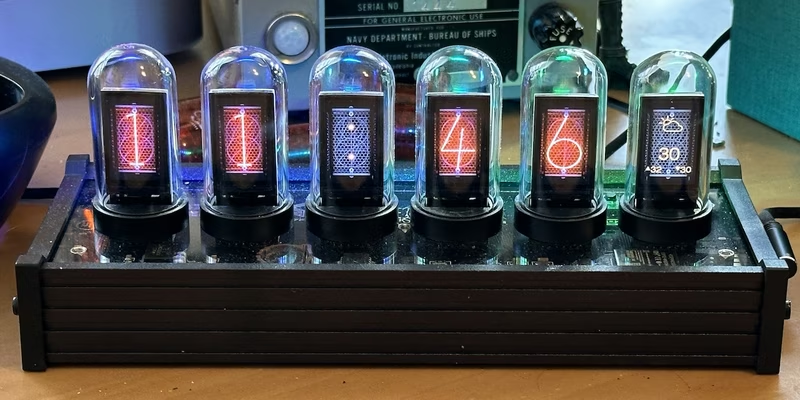
EleksTube IPS Custom Firmware
This project provides a feature-rich custom firmware for ESP32-based EleksTube IPS digital clocks, enabling internet time synchronization and weather updates. It utilizes the TFT_eSPI library for high-quality display management and LittleFS for asset storage, while offering a web-based configuration portal and MQTT integration for smart home ecosystems.
ESP32 U2F Security Key
This project transforms ESP32-S2 and ESP32-S3 microcontrollers into hardware security tokens supporting FIDO2/U2F, OpenPGP, PIV, and OATH protocols. It leverages the ESP-IDF framework, FreeRTOS, and the LittleFS file system to provide a secure authentication solution using native USB-OTG capabilities.
EnergyMe-Home
An open-source energy monitoring system built on the ESP32-S3 and ADE7953 IC, capable of tracking up to 17 circuits. It features a task-based FreeRTOS architecture and supports multiple integration protocols including MQTT, Modbus TCP, and InfluxDB.
BLEOTA: ESP32 OTA Updates over BLE
A library for ESP32 that enables firmware and filesystem (SPIFFS/LittleFS) updates over Bluetooth Low Energy. It supports both BlueDroid and NimBLE stacks, offering features like data compression, secure RSA-based signature verification, and customizable callbacks for update monitoring.

ESP32 SDL3 Swift Example
A graphical application example for ESP32 microcontrollers using the Swift 6.1 programming language and SDL3. It supports various Espressif SoCs including ESP32-C3, ESP32-C6, and ESP32-P4, utilizing ESP-IDF 5.4 and LittleFS for asset management.