MCUboot
v2.3.0Features
-
Secure bootloader functionality for 32-bit microcontrollers with image integrity and authenticity verification.
-
Hardware and operating system independent architecture utilizing hardware porting layers for integration.
-
Support for multiple RTOS environments including Zephyr, Apache Mynewt, Apache NuttX, RIOT, and Mbed OS.
-
Core bootutil library for image management, verification, and update state tracking.
-
Integrated imgtool utility for secure firmware image signing and header/TLV generation.
-
Support for multiple signature algorithms including RSA-2048, RSA-3072, ECDSA-P256, and ED25519.
-
Flexible flash layout management utilizing primary and secondary image slots for fail-safe updates.
-
Swap-based update mechanism with support for swap-using-scratch and direct-image-upload modes.
-
Serial recovery protocol (SMP) over UART or USB CDC ACM for firmware rescue and updates.
-
Downgrade prevention using version numbers or security counters to block older firmware versions.
-
Hardware-assisted Secure Boot and Flash Encryption support for specific SoCs like Espressif.
-
Simulator environment for testing bootloader logic and regression analysis on POSIX systems.
-
Support for multiple updateable images allowing independent updates of different system components.
-
Watchdog timer integration to prevent boot loops during failed or hung firmware updates.
-
TLV (Type-Length-Value) based image trailer for extensible metadata storage and verification.
-
Support for encrypted firmware images to maintain confidentiality during transport and storage.
Architecture
MCUboot is designed with a modular architecture that separates core bootloader logic from hardware-specific and OS-specific implementations. The core of the system is the bootutil library, which handles image verification, state management, and the complex logic of swapping firmware images between flash slots. This core interacts with a hardware porting layer that abstracts flash memory operations (read, write, erase) and cryptographic primitives.
The system flash layout is typically divided into multiple partitions: a bootloader partition, a primary slot (where the active image resides), a secondary slot (where update images are staged), and an optional scratch partition used for atomic image swapping. Firmware images follow a specific format consisting of a header (containing version and size info), the executable binary payload, and a trailer containing Type-Length-Value (TLV) records for cryptographic hashes and digital signatures.
Core Components
- bootutil: The central library managing image validation and the update state machine.
- imgtool: A Python-based utility for signing binaries and generating MCUboot-compatible image headers.
- boot_serial: A subsystem providing serial recovery capabilities via the Simple Management Protocol (SMP).
- Hardware Porting Layer: OS-specific implementations for Zephyr, Mynewt, NuttX, and others that map MCUboot requirements to platform APIs.
Use Cases
This library is ideal for:
- Secure Firmware Updates (OTA): Providing a fail-safe mechanism to download, verify, and install new firmware images over-the-air while ensuring only authorized code is executed.
- Anti-Rollback Protection: Preventing attackers from downgrading a device to an older, vulnerable firmware version using hardware-backed security counters.
- Multi-Image Systems: Managing complex devices that require independent updates for different processors or subsystems (e.g., an application core and a network core).
- Serial Recovery: Enabling factory or field recovery of bricked devices through a standardized serial protocol when the main application fails to boot.
- Confidentiality in Storage: Utilizing flash encryption and encrypted image support to protect intellectual property and sensitive data on external flash chips.
Getting Started
To begin developing with MCUboot, developers should first define the flash partition map in their target’s device tree or configuration files, ensuring slots are large enough for the intended application. The imgtool utility is required to sign binaries; a typical command involves imgtool.py sign with a specified RSA or EC private key. For Zephyr users, enabling CONFIG_BOOTLOADER_MCUBOOT=y in the application configuration automates much of the integration. Detailed documentation for each supported RTOS is located in the docs/ directory of the repository, covering specific build instructions for Zephyr, Apache Mynewt, and Espressif SoCs. Developers are encouraged to use the provided simulator in the sim/ directory for testing custom flash logic or update scenarios in a safe, virtualized environment.
Related Projects (9)
McuManager iOS
A transport-agnostic implementation of the McuManager protocol for iOS, enabling over-the-air (OTA) firmware upgrades and device management for microcontrollers running Zephyr or Apache Mynewt. It provides a modular architecture with specialized managers for image handling, file system access, and system logging.
mcumgr-dart
A Dart client library for the mcumgr protocol, enabling device management and firmware updates for embedded systems running Apache Mynewt or Zephyr. It provides a transport-agnostic implementation of the Simple Management Protocol (SMP) with support for CBOR encoding and optimized image uploads.
Mender OTA Example for STM32L4 and Zephyr RTOS
A demonstration project showcasing over-the-air (OTA) update capabilities using the Mender MCU client on STM32L4 hardware. It utilizes the Zephyr RTOS and a W5500 Ethernet module to connect to Mender servers for firmware deployment, remote troubleshooting, and device management.
Golioth Firmware SDK
A comprehensive software development kit for connecting embedded devices to the Golioth IoT cloud. It provides robust middleware for OTA updates, data streaming, remote logging, and device management across platforms like Zephyr, ESP-IDF, and ModusToolbox.
Herald for C++
A C++17 implementation of the Herald Bluetooth Protocol and Payload for native platforms, including Zephyr RTOS and Windows. It provides a privacy-preserving proximity detection and data exchange framework specifically optimized for Nordic Semiconductor nRF52 and nRF53 series microcontrollers.
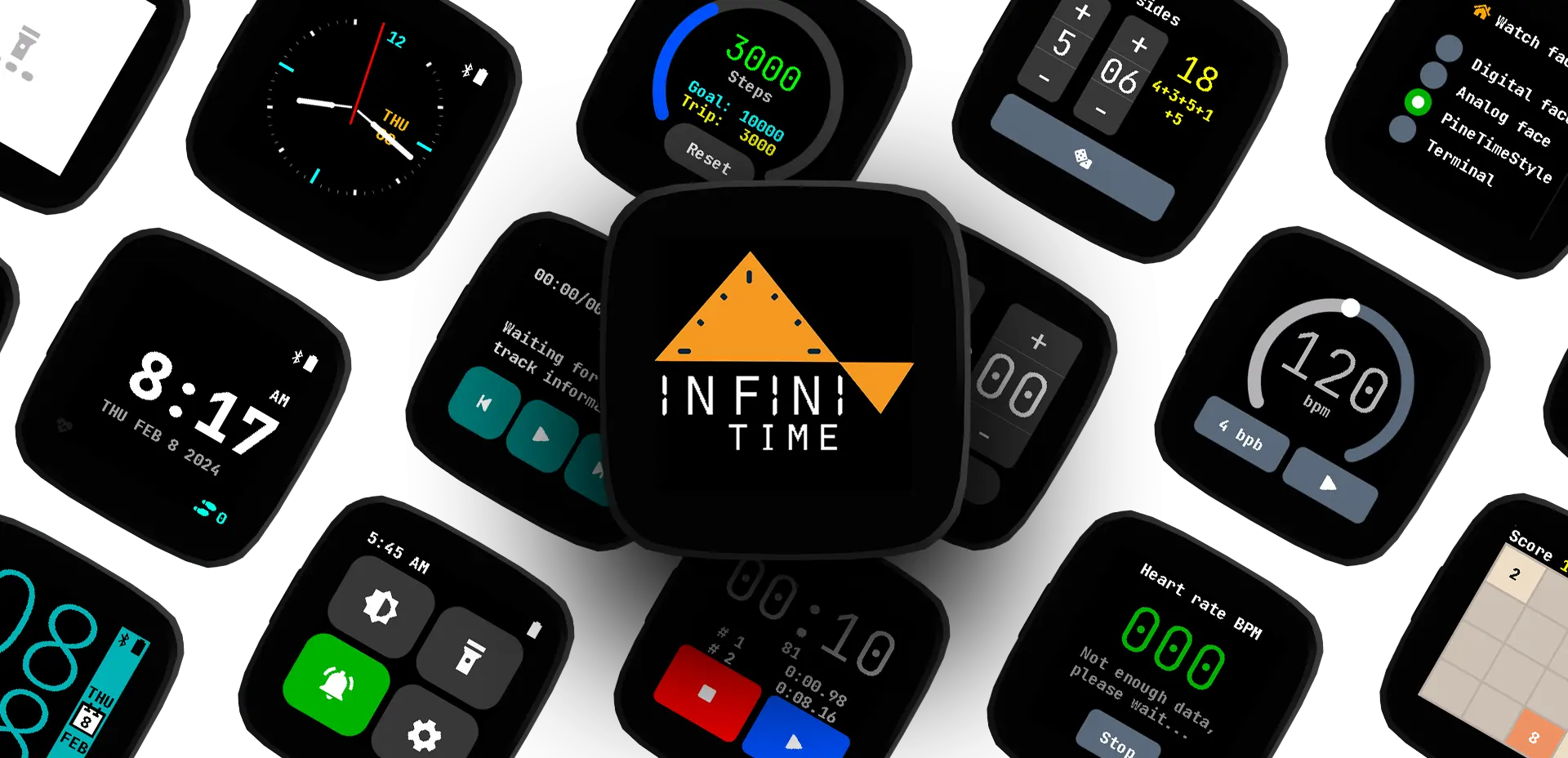
InfiniTime
An open-source firmware for the PineTime smartwatch based on the nRF52832 microcontroller. It utilizes FreeRTOS for task management, LVGL for the user interface, and NimBLE for Bluetooth Low Energy connectivity. The project provides a complete suite of applications, watch faces, and OTA update capabilities for the PineTime hardware.
Awesome Zephyr RTOS
A curated collection of high-quality resources, libraries, tools, and learning materials for the Zephyr RTOS ecosystem. It serves as a comprehensive directory for developers looking for official documentation, community-supported libraries, and hardware platforms compatible with Zephyr.