ChibiOS/RT
ver21.11.5Features
-
Dual-kernel architecture offering the full-featured RT kernel and the ultra-compact NIL kernel for varying resource constraints.
-
Comprehensive Hardware Abstraction Layer (HAL) providing a unified interface for MCU peripherals across multiple vendors.
-
Dedicated functional safety module (SFT) implementing system and list integrity checks for high-reliability applications.
-
Support for multicore and NUMA architectures using specialized memory class modifiers to handle non-coherent caches.
-
Advanced sandboxing capabilities including para-virtualized ports, virtual IRQ mechanisms, and memory protection.
-
Virtual File System (VFS) integration supporting LittleFS and FatFS with per-sandbox instance visibility.
-
Optimized context switching for ARM Cortex-M that avoids FPU register saving for threads not utilizing the floating-point unit.
-
Dynamic thread management featuring a thread registry garbage collector and customizable dispose functions.
-
Managed Flash Storage (MFS) driver with flash-level mutual exclusion and wear-leveling support.
-
POSIX-compatible mini shell (msh) and enhanced XShell for command-line interaction and sub-app execution.
-
Support for loading and executing ELF files within isolated sandboxed environments.
-
Static MPU initialization for ARMv7-M and ARMv8-M architectures to enforce memory boundaries at boot.
-
Virtual timers with runtime delta recalculation for high-precision timing and reduced jitter.
-
Object-oriented framework (OOP) in C for structured and modular OS module development.
-
Support for CMSIS-RTOS and NASA OSAL emulation layers for legacy code compatibility.
-
Extensive test suite including kernel tests, HAL integration tests, and MISRA-C compliance checks.
Architecture
ChibiOS is designed with a highly modular and layered architecture that centers around its unique dual-kernel approach. The system provides two distinct kernels: the RT (Real-Time) kernel, which is a full-featured, high-performance preemptive RTOS, and the NIL kernel, which is an ultra-compact implementation designed for extremely resource-constrained microcontrollers. Both kernels share a common API philosophy and can utilize the same high-level OS libraries (OSLIB), allowing developers to scale their applications based on hardware capabilities without rewriting core logic.
Beyond the kernels, the architecture includes a robust Hardware Abstraction Layer (HAL) that provides a standardized interface for peripherals like GPIO, UART, I2C, and SPI across different MCU families. A specialized Virtual File System (VFS) layer abstracts storage devices, while the Sandbox (SB) component enables application isolation through memory protection and para-virtualization. The system also incorporates an object-oriented framework (OOP) written in C, which facilitates the development of structured and maintainable OS modules.
Use Cases
This RTOS is ideal for:
- Industrial Automation: High-performance real-time control using the RT kernel’s low-latency context switching and deterministic scheduling.
- Functional Safety: Applications requiring high reliability, leveraging the dedicated SFT module for runtime integrity checks and MISRA-C compliance.
- Resource-Constrained IoT: Deploying the NIL kernel on small microcontrollers to minimize RAM and Flash footprint while maintaining RTOS capabilities.
- Secure Edge Computing: Utilizing sandboxing and MPU-based isolation to run untrusted or third-party applications securely.
- Automotive Systems: Leveraging multicore and NUMA support for complex Electronic Control Unit (ECU) development on modern ARM architectures.
- Embedded Storage Solutions: Implementing robust data logging using the Managed Flash Storage (MFS) and VFS with LittleFS or FatFS.
Getting Started
ChibiOS is organized into a clear directory structure where the os/ folder contains the core components and demos/ provides platform-specific examples for various evaluation boards. To begin development, it is recommended to select a demo project that matches your hardware target; these demos typically include pre-configured Makefiles and project files for ChibiStudio or other GCC-based toolchains.
Key configuration is handled through header files: chconf.h for kernel settings, halconf.h for peripheral driver selection, and mcuconf.h for clock and DMA configurations. The root directory contains a documentation.html file which serves as the primary entry point for the Doxygen-generated API reference. Developers can also find extensive test suites in the test/ directory to verify kernel and HAL integrity on their specific hardware ports.
Related Projects
NoiseCard
NoiseCard is an ultra-low-power ambient noise monitor built on the STM32G0 microcontroller and ChibiOS RTOS. It measures decibel levels periodically and provides visual feedback via LEDs, designed to run entirely on direct solar power with minimal energy consumption.
Mercury Transforming Drone
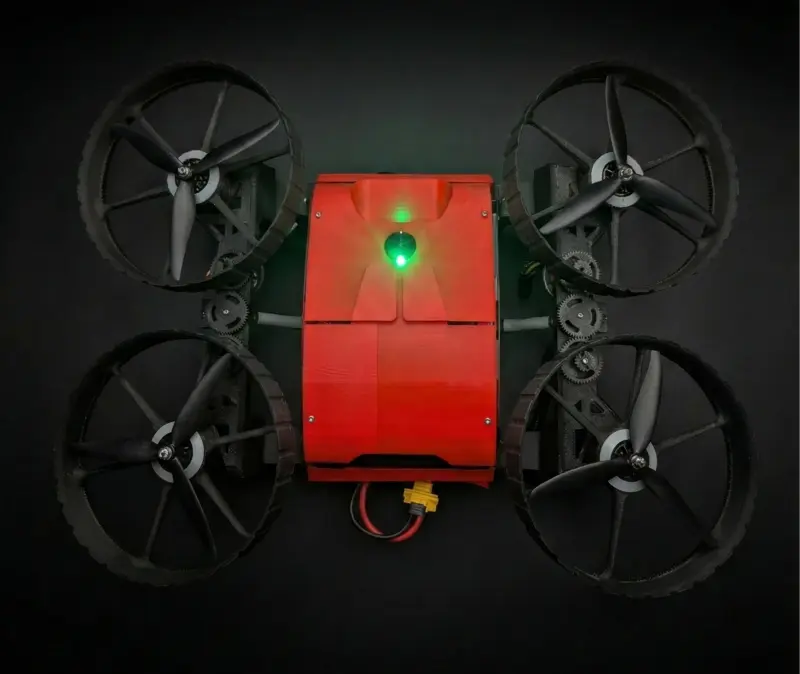
Mercury is a multi-modal transforming drone platform that combines aerial flight and ground-based driving capabilities. It utilizes a Raspberry Pi 5 for high-level autonomy and an ArduPilot-based flight controller for stable dynamics, featuring a unique transformation mechanism powered by linear actuators.
Loongcat40 Keyboard
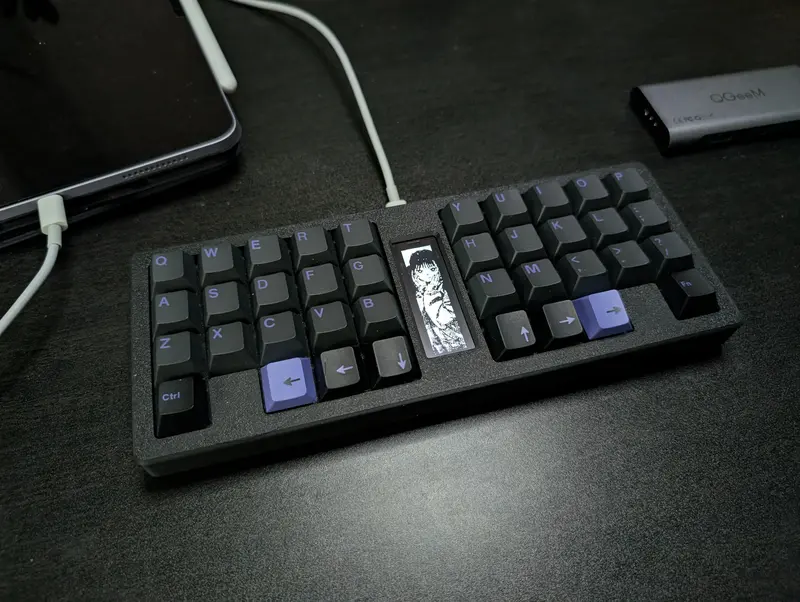
A 4x10 gasket-mounted mechanical keyboard powered by the Raspberry Pi Pico (RP2040). It features a large 2.08-inch SH1122 OLED display and utilizes QMK firmware for extensive customization.
NanoVNA-X: Enhanced Firmware for NanoVNA H/H4
An advanced, event-driven firmware for NanoVNA-H and NanoVNA-H4 handheld vector network analyzers. Built on the ChibiOS RTOS, it features a modular architecture, non-blocking USB communication, and a zero-copy sweep pipeline optimized for STM32F072 and STM32F303 microcontrollers.
ChibiOS/RT Examples for STM32F401RE Nucleo
A comprehensive collection of example projects for ChibiOS/RT 21.11.x and the ChibiOS HAL, specifically tailored for the STM32F401RE Nucleo-64 board. It covers essential embedded peripherals including GPIO, ADC, PWM, and ICU, alongside core RTOS concepts like multithreading and shell integration.
Struts4Embedded (S4E)
An MVC framework for embedded systems that mimics Java's Struts 1.0 architecture to decouple model, view, and controller logic. Built specifically for ChibiOS RTOS, it provides a structured pattern for developing scalable and maintainable IoT applications on STM32 microcontrollers.
MotoLink
An open-source CAN Bus and K-Line interface for motorcycles featuring fuel and ignition mapping capabilities. Built on ChibiOS/RT for STM32 microcontrollers, it enables communication with Honda HRC and Yamaha YEC ECUs to create custom fuel maps based on real-time sensor data.
ChibiOS
ChibiOS is a complete development environment for embedded applications, featuring the RT and NIL real-time kernels along with a comprehensive Hardware Abstraction Layer (HAL). It provides a scalable architecture for microcontrollers ranging from tiny 8-bit AVRs to high-performance ARM Cortex-M7 and SPC5 devices.