Zephyr
v4.4.2Features
-
Multi-threading services supporting cooperative, priority-based, and preemptive threads with POSIX pthreads compatibility.
-
Multiple scheduling algorithms including Earliest Deadline First (EDF) and Meta IRQ for interrupt bottom-half behavior.
-
Configurable memory protection including stack-overflow protection, kernel object permission tracking, and thread isolation.
-
Native, fully-featured networking stack supporting IPv4/IPv6, LwM2M, and BSD sockets.
-
Comprehensive Bluetooth 5.0 Low Energy support with host and controller stacks, including Mesh networking.
-
Hardware description via Devicetree to decouple application code from hardware specifics.
-
Optimized device driver model for consistent initialization and cross-platform driver reuse.
-
Virtual File System (VFS) interface supporting ext2, FatFs, and LittleFS.
-
Advanced power management with system-wide and fine-grained device-level policies.
-
Compile-time resource definition to minimize memory footprint and improve performance.
-
Multi-backend logging framework with support for filtering, object dumping, and panic modes.
-
Full-featured shell interface with autocompletion, history, and dynamic sub-commands.
-
Non-volatile storage (NVS) and settings subsystem for persistent key-value pair storage.
-
Support for Symmetric Multiprocessing (SMP) on multi-core systems.
-
Native port (native_sim) for running Zephyr as a native application on Linux, macOS, or Windows for testing.
-
Integrated cryptographic libraries and security documentation for building secure embedded applications.
-
Extensive library of over 1,000 supported boards and shields.
-
Modular subsystem design allowing applications to include only necessary capabilities.
Architecture
Zephyr is built upon a highly modular, small-footprint kernel designed for resource-constrained environments. The architecture is centered around a microkernel-like design where services are provided as optional modules. It utilizes a unified device driver model that abstracts hardware interactions, allowing for high portability across different SoCs and architectures. A key architectural pillar is the use of Devicetree (DTS) to describe hardware topology and Kconfig for compile-time configuration, ensuring that only the required code and drivers are included in the final binary image.
The system supports both single-core and Symmetric Multiprocessing (SMP) configurations. The kernel provides essential RTOS services such as multi-threading, interrupt management, and inter-thread synchronization (mutexes, semaphores, and message queues). Above the kernel layer, Zephyr includes a rich set of subsystems including a native networking stack, a comprehensive Bluetooth stack, and various file system wrappers, all interacting through standardized APIs to maintain modularity and scalability.
Core Components
- Kernel: Handles scheduling, threads, and low-level synchronization.
- Device Driver Model: Provides a consistent API for interacting with peripherals like GPIO, UART, I2C, and SPI.
- Networking Subsystem: A native, fully-featured stack supporting multiple protocols from the physical layer to the application layer.
- Bluetooth Stack: Includes both a Host and a Controller implementation for BLE and Mesh.
- Power Management: Offers system-wide and device-specific power state control.
Use Cases
This RTOS is ideal for:
- IoT Sensors: Low-power environmental sensors requiring long battery life and secure wireless connectivity (e.g., NB-IoT, LoRaWAN).
- Wearables: Smartwatches and fitness trackers that need a small footprint, Bluetooth connectivity, and sophisticated power management.
- Industrial Automation: Embedded controllers and gateways requiring deterministic scheduling and support for industrial protocols like CAN and Ethernet.
- Smart Home Devices: Connected appliances and lighting systems utilizing Thread or Bluetooth Mesh for reliable local networking.
- Medical Devices: Resource-constrained diagnostic tools that benefit from Zephyr’s focus on security and memory protection.
Getting Started
To begin developing with Zephyr, developers should use the West tool, Zephyr’s multi-purpose command-line utility. The setup process involves installing host dependencies (CMake, Python, Devicetree compiler), initializing a West workspace to clone the Zephyr source and its modules, and installing the Zephyr SDK, which contains the necessary cross-compilation toolchains. Once the environment is set up, applications can be built using the west build command and flashed to supported hardware via west flash. Detailed documentation, including a comprehensive ‘Getting Started Guide’ and hundreds of code samples, is available at https://docs.zephyrproject.org.
Related Projects
View All Projects →Ostomachion
Ostomachion is a modular FPGA-based platform integrating a NEORV32 RISC-V SoC with the Zephyr RTOS on Xilinx Artix-7 hardware. It features a fully programmatic Vivado build flow and a specialized DMA-driven spectral filter pipeline for real-time signal processing, complete with a C++20 hardware abstraction layer.
Edge Impulse SDK Zephyr Module
A portable C++ library for digital signal processing and machine learning inferencing integrated as a native Zephyr RTOS module. It enables the deployment of optimized ML models across hundreds of hardware targets using the West build system and custom extension commands for automated model management.
Xaloqi Embedded Diagnostics Suite (EDS)
A production-grade UDS diagnostic stack for Zephyr RTOS and FreeRTOS that automates ISO 14229 compliance through a YAML-driven code generation workflow. It features ASIL-B safety wrappers, ISO-TP and DoIP transport support, and comprehensive testing tools for automotive and industrial ECUs.
bleRPC
bleRPC is a high-performance framework for type-safe Remote Procedure Calls (RPC) over Bluetooth Low Energy, supporting platforms ranging from Zephyr-based microcontrollers to mobile and desktop environments. It leverages Protocol Buffers for code generation and implements a robust three-layer protocol stack to handle MTU-aware fragmentation and optional end-to-end encryption. The project is designed for efficiency, capable of running on devices with only 32 KB of RAM while achieving throughput up to 59 KB/s.
TinyMLDelta
TinyMLDelta provides a framework for incremental binary model updates on TinyML and embedded AI devices, reducing OTA bandwidth by up to 99% through diff patching. The project includes a Python-based patch generator and a platform-agnostic C runtime that manages atomic A/B model swaps, crash-safe journaling, and compatibility guardrails for TensorFlow Lite Micro models.
Network Provisioning for Zephyr RTOS
A Zephyr RTOS port of Espressif's network provisioning protocol, enabling secure Wi-Fi or Thread configuration over BLE, SoftAP, or device console. It integrates with Zephyr's native subsystems like wifi_credentials and net_mgmt while maintaining compatibility with official Espressif provisioning mobile apps.
BLE Sniffer for nRF54L15
A high-efficiency, passive BLE advertising packet sniffer for the Nordic nRF54L15-DK powered by Zephyr RTOS. It utilizes zero-copy pipelines and deferred logging to ensure high throughput and minimal packet loss during dense wireless traffic.
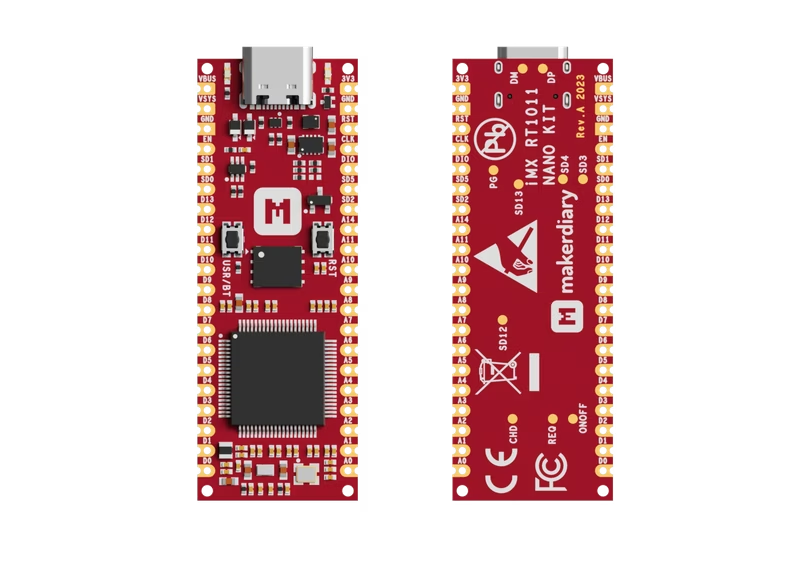
iMX RT1011 Nano Kit
A high-performance development board featuring the NXP iMX RT1011 Crossover MCU with an ARM Cortex-M7 core running at 500MHz. It supports the Zephyr RTOS and Python environments, offering 128 KB RAM, 128 Mb QSPI Flash, and a compact USB-C form factor for rapid prototyping.